
AI Integration Roadmap for Malaysian Businesses


Most Malaysian businesses do not have an AI problem first. They have an implementation problem.
The idea is usually easy to agree on. The hard part is deciding where AI should sit in a real workflow, how it will connect to current systems, who approves the output, what data can safely be used, and what happens when the result is wrong or incomplete.
That is why an AI integration roadmap matters. It turns AI from a broad ambition into an executable sequence: pick the right use case, design the workflow, govern the data, integrate with production systems, test the handoffs, then scale only after the first implementation proves itself.
For Malaysian businesses, that sequence matters even more. Many teams are operating with a mix of legacy systems, spreadsheets, email approvals, WhatsApp coordination, vendor-managed processes, and regionally distributed teams. In that environment, AI is rarely a drop-in feature. It is usually a new decision layer inside an existing business process.
This article is written for founders, operators, and heads of function who want a practical answer to one question:
What should an AI integration roadmap actually look like for a Malaysian business that wants business value, not just a demo?
Start with business friction, not model excitement
A weak roadmap starts with technology selection.
A stronger roadmap starts with operational friction.
Before you discuss models, copilots, or vendors, list the workflows where your team is already losing time, consistency, or margin. In many Malaysian businesses, those pain points show up in familiar places:
- customer service teams handling repetitive inbound questions across email, forms, and chat
- finance teams reviewing invoices, payment references, and supporting documents manually
- sales teams summarising meetings and updating CRM records late
- operations teams reconciling orders, fulfilment updates, and exception handling across multiple systems
- internal support teams answering repeated HR, IT, or policy questions
That is a better starting point because AI value usually comes from improving a workflow, not from deploying a model in isolation.
A useful filter is simple: if the workflow is already painful, repetitive, and rules-driven, it may be a roadmap candidate. If the workflow is chaotic, undocumented, or politically disputed, fix the workflow first.
The roadmap should move in phases, not one big leap
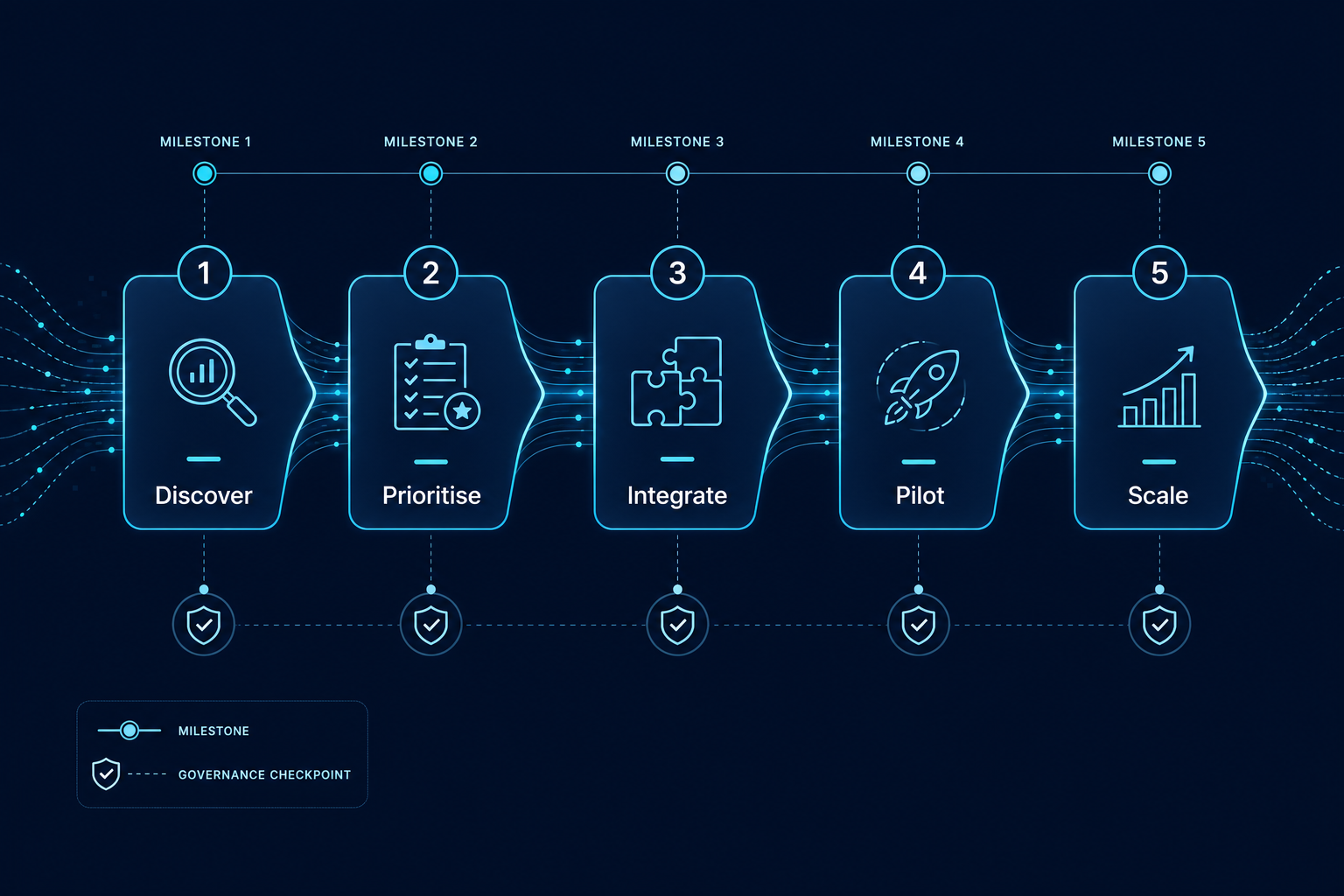
A practical AI integration roadmap usually has five phases.
Phase 1: Select one workflow that is narrow enough to govern
Choose one workflow with clear boundaries.
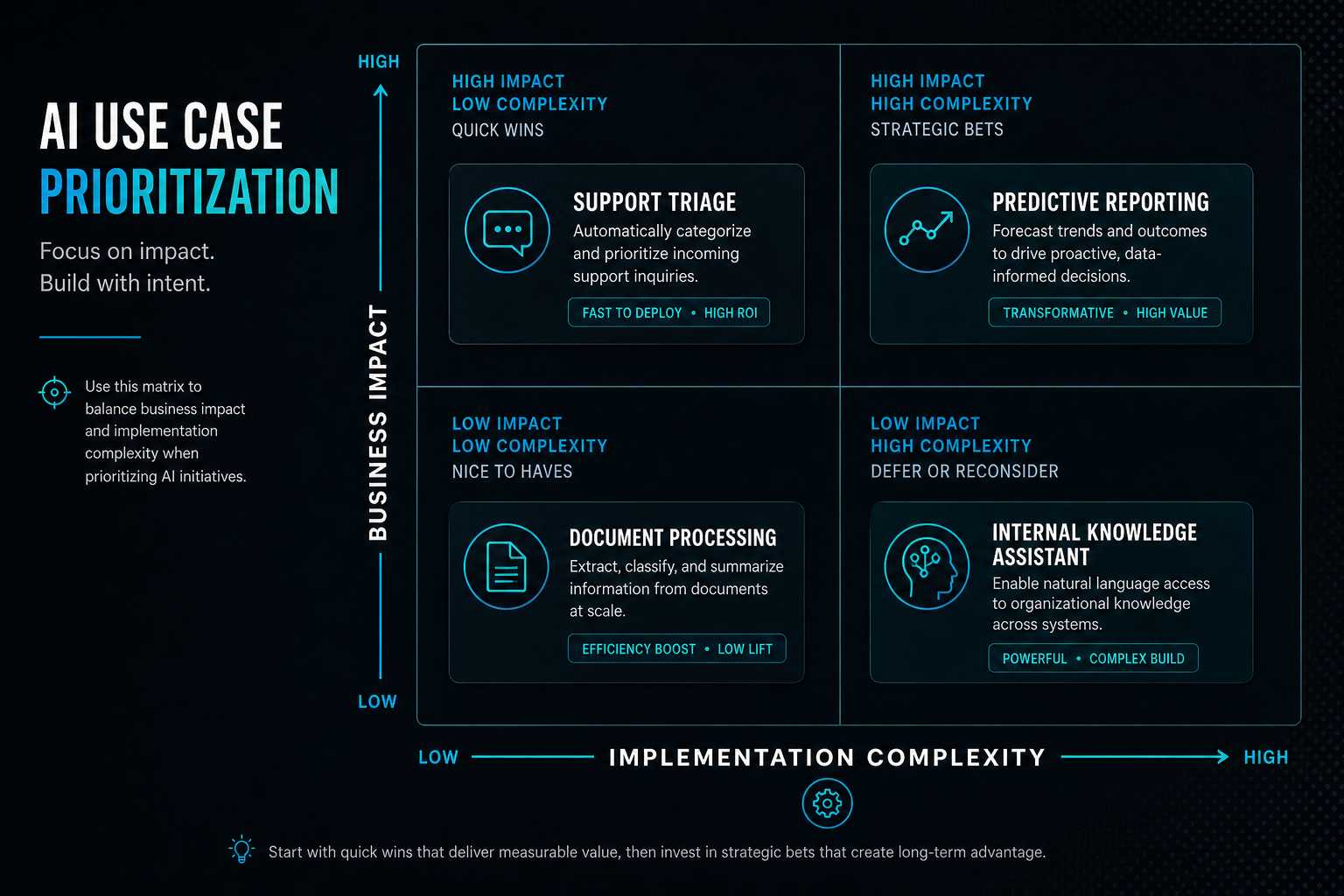
Good early candidates are usually high-volume tasks where:
- the input arrives in a reasonably consistent form
- the output can be reviewed before it becomes final
- the business can define what a useful result looks like
- a fallback manual path already exists
Examples include:
- draft-first customer replies for support review
- invoice or form data extraction into an internal system
- internal knowledge search for policy or SOP questions
- summarisation of meeting notes into structured CRM fields
- triage and categorisation of inbound requests
Bad first candidates are usually broad, high-risk, or deeply cross-functional initiatives such as "replace our operations team with AI" or "automate all decision-making in customer onboarding."
The first roadmap step is not to prove that AI is magical. It is to prove that one workflow can be improved safely and measurably.
Phase 2: Define the workflow and decision points clearly
This is where many projects slow down, and that is normal.
Before implementation starts, write down:
- what triggers the workflow
- what input data the AI receives
- what output it is expected to produce
- who reviews, edits, or approves the output
- which system stores the final approved result
- what happens if the AI output is low-confidence, wrong, or unavailable
That sounds basic, but it is where implementation reality appears.
For example, a customer service use case is not just "use AI to answer customers." It is closer to: "When a level-one support request enters the helpdesk, generate a suggested reply and category tag, route it to a support agent for approval, log edits for QA review, and save the approved answer into the ticket system."
That level of clarity is what makes integration possible.
Malaysian context: governance and compliance cannot be an afterthought
In Malaysia, AI implementation has to be commercially useful, but it also has to be governable.
That means the roadmap should account for policy and compliance early, especially when workflows involve customer records, employee data, pricing, contracts, or regulated operating processes.
Three practical governance checkpoints matter from the start.
1. Personal data handling under PDPA expectations
If the workflow touches personal data, your team needs to know what data is being processed, why it is being used, where it flows, and who can access it.
For operators, the practical question is not "Are we doing advanced AI?" It is: Are we moving personal or sensitive business data into a new processing flow without enough control, visibility, or approval?
If the answer might be yes, the roadmap needs data classification, minimisation, retention rules, and review by the relevant internal owner before rollout.
2. Internal accountability and approval rights
Every AI-assisted workflow needs named business ownership.
Someone has to decide:
- which outputs are suggestions only
- which outputs can move to the next step with review
- which outputs must never auto-execute
- which exceptions require escalation
- which KPI determines whether the implementation is working
Without this, teams end up with a pilot that technically works but is operationally orphaned.
3. Risk controls for production usage
A real roadmap must include controls for prompt changes, access rights, audit logs, exception handling, and rollback.
This is especially important for Malaysian businesses working across multiple departments, outsourced support functions, or regional entities where one workflow may touch several systems and approval layers.
Integration matters more than the AI demo
Many teams underestimate this point.
The model is often the easiest part to show in a meeting. Integration is the harder part to ship.
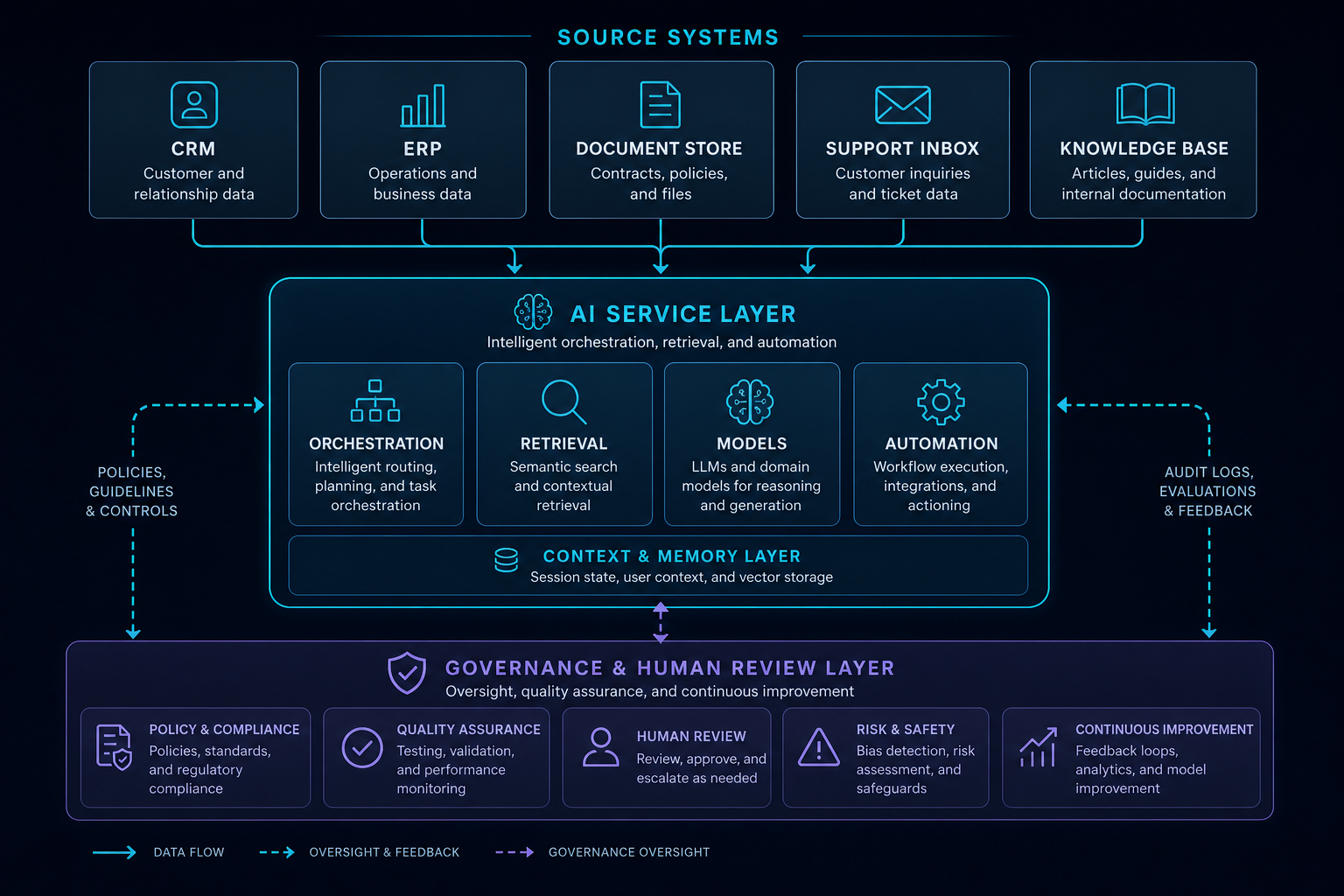
In live environments, AI usually needs to sit between systems that were not originally designed to work together cleanly. That may include ERP platforms, CRM tools, custom portals, finance software, document repositories, customer support systems, or internal databases.
So the roadmap should answer four integration questions early.
Where does the source data come from?
Can the workflow pull the required input through APIs, queues, exports, or controlled database access?
If data is trapped inside spreadsheets, PDFs, email threads, or inconsistent manual entry, the roadmap must account for extraction, validation, and cleanup work.
Where does the output go?
If the AI produces a draft, summary, tag, or recommendation, where is that result stored? Does it go back into the CRM, helpdesk, ERP, or an approval dashboard?
If the output has nowhere structured to land, teams usually fall back to copy-paste operations, which kills scale quickly.
How is status tracked?
A production workflow needs visibility.
The business should be able to see whether an item is:
- waiting for AI processing
- routed for human review
- approved
- rejected
- retried
- failed and handed back to manual processing
Without this, the team cannot operate the workflow confidently.
What is the fallback path?
This is one of the most important roadmap decisions.
If the AI service fails, produces poor output, or receives bad input, what happens next? Does the item go to a manual queue? Does the system retry? Does the workflow stop and alert an owner?
A roadmap without fallback is not a production roadmap. It is a demo plan.
Use a staged rollout instead of a big-bang launch
For most Malaysian businesses, the safest path is staged rollout.
A practical example: customer support triage and reply drafting
A useful early example for many Malaysian businesses is customer support triage.
Imagine inbound requests arriving through email, web forms, or chat. Instead of asking AI to fully handle customer service, the roadmap can focus on a narrower first step:
- classify the request type
- suggest a draft reply
- surface the relevant SOP or policy reference
- route the item to a human reviewer before anything is sent
That kind of workflow is easier to govern because the boundaries are clear. The input is visible, the output can be reviewed, the fallback path already exists, and the business can measure whether response time improves without increasing customer risk.
This is the kind of scoped rollout that helps teams learn where AI genuinely fits before they expand into more sensitive or cross-functional workflows.
That usually means:
Stage 1: Human-in-the-loop pilot
The AI produces a draft or recommendation. A human reviews every result.
This stage is used to validate:
- input quality
- output usefulness
- review effort
- common failure modes
- operational fit with the current team
Stage 2: Controlled production with metrics
The workflow remains reviewable, but the business starts measuring throughput, turnaround time, acceptance rates, exception rates, and operational savings.
This stage is about proving real performance, not just subjective excitement.
Stage 3: Selective automation of low-risk steps
Only after the first two stages are stable should the business consider limited automation of low-risk actions.
For example:
- auto-tagging inbound requests
- auto-routing cases to the right queue
- pre-filling structured fields before approval
- generating internal summaries for staff use
High-risk decisions involving money, legal commitments, regulated records, or customer promises should remain tightly controlled unless there is a strong case, strong testing, and clear ownership.
What Malaysian founders and operators should measure
The roadmap should be tied to business measures that leadership already understands.
That usually means tracking:
- turnaround time before and after implementation
- percentage of output accepted with minor or no edits
- exception rate and common causes
- staff time returned to higher-value work
- reduction in repetitive manual handling
- quality consistency across branches, teams, or support shifts
Avoid vanity metrics like prompt count, model novelty, or internal excitement.
The point of the roadmap is not to say the business "uses AI." The point is to improve throughput, quality, visibility, or response time in a way operations can defend.
Common roadmap mistakes to avoid
Mistake 1: Starting too broad
If the first use case spans too many teams, systems, or exceptions, the implementation drags before the business learns anything useful.
Mistake 2: Treating governance as legal clean-up later
If data handling, approval rights, and audit expectations are only discussed near go-live, the team often has to redesign the workflow late.
Mistake 3: Assuming integration will be straightforward
Even a simple AI feature can become expensive if source systems are inconsistent or downstream workflows were never documented.
Mistake 4: Measuring only model output quality
A workflow can have decent AI output and still fail operationally because the queue design, approval steps, monitoring, or fallback path are weak.
Mistake 5: Scaling before the first workflow is truly stable
If the business cannot run one AI-supported workflow cleanly, adding five more will multiply confusion, not value.
A practical 90-day roadmap shape
Every business will differ, but a realistic first roadmap often looks like this:
Days 1-30: Scope and readiness
- choose one workflow
- map the current process
- identify systems, data sources, and decision points
- classify data and governance needs
- define success metrics and fallback rules
- confirm business owner and technical owner
Days 31-60: Build and integration
- implement the workflow service or integration layer
- connect source and destination systems
- configure prompts, rules, and review logic
- create logging, status visibility, and exception paths
- prepare test cases based on real historical examples
Days 61-90: Pilot and production hardening
- run a human-reviewed pilot
- measure accuracy, review effort, and throughput impact
- tune prompts, rules, and handoff design
- document failure modes and operational SOPs
- decide whether the workflow is ready for wider rollout
That is not a universal formula, but it is closer to how durable implementations actually get shipped.
Where Virtualspirit fits in
This is the part many businesses get wrong when they evaluate AI support.
They look for a vendor that can demonstrate a model. What they usually need is a partner that can assess workflow reality, design the integration path, build the operational controls, and support production rollout across the existing stack.
That is where Virtualspirit fits best.
As a software and AI implementation agency, Virtualspirit is most valuable when the assignment is not "show us AI," but rather:
- identify the right workflow to start with
- architect the integration with current systems
- build the approval, logging, and exception layers
- keep the rollout commercially realistic for operators and management
- create a path from pilot to production without losing governance
In other words, the job is not only to make AI work. It is to make AI work inside the business you already run.
Final takeaway
A strong AI integration roadmap for Malaysian businesses is not a slide deck about transformation. It is a sequence of operational decisions.
Pick one workflow. Define the handoffs. Govern the data. Integrate with the systems that already matter. Launch with review and fallback. Measure operational value. Then scale from evidence, not enthusiasm.
That is the difference between an AI initiative that stays in presentation mode and one that becomes part of daily operations.
CTA
Planning an AI rollout for your business in Malaysia?
If you need help choosing the right first workflow, mapping system handoffs, or turning an AI pilot into a production-ready implementation, Virtualspirit can help.
- Book an AI roadmap session with Virtualspirit
- Assess one workflow before committing to a broader build
- Design a pilot-to-production path your operations team can actually run
Sources
- Malaysia National AI Office (NAIO): https://ai.gov.my/
- Jabatan Perlindungan Data Peribadi (PDPA Malaysia): https://www.pdp.gov.my/jpdpv2/en/akta-709/personal-data-protection-act-2010/
- Malaysia Digital Economy Corporation (MDEC): https://mdec.my/
- NIST AI Risk Management Framework: https://www.nist.gov/itl/ai-risk-management-framework
- OECD AI Principles: https://oecd.ai/en/ai-principles
FAQ
1. What is the best first AI use case for a Malaysian business?
Start with one narrow workflow that is repetitive, high-volume, and reviewable. Good early use cases usually involve summarisation, classification, extraction, or internal knowledge support rather than high-risk autonomous decisions.
2. Do Malaysian businesses need to worry about PDPA when implementing AI?
Yes. If the workflow involves personal data, the roadmap should address what data is being processed, who can access it, where it is stored, how long it is retained, and what controls apply before production use.
3. Should we build one big AI platform first?
Usually no. Most teams get better results by improving one real workflow first, proving operational value, and then expanding from a stable integration pattern instead of funding a broad platform before the business case is clear.
4. How long should an initial AI integration roadmap take?
For one well-defined workflow, many teams can complete discovery, integration, and a controlled pilot within roughly 60 to 90 days, assuming ownership, data access, and system cooperation are already available.
5. What does an AI implementation agency actually do in this roadmap?
A strong implementation partner helps choose the right workflow, design the system handoffs, build the integration and review layers, manage operational risk, and support the move from pilot to production.